New system uses projected light circles to manage personal space and pedestrian flow, prompting both praise and confusion.
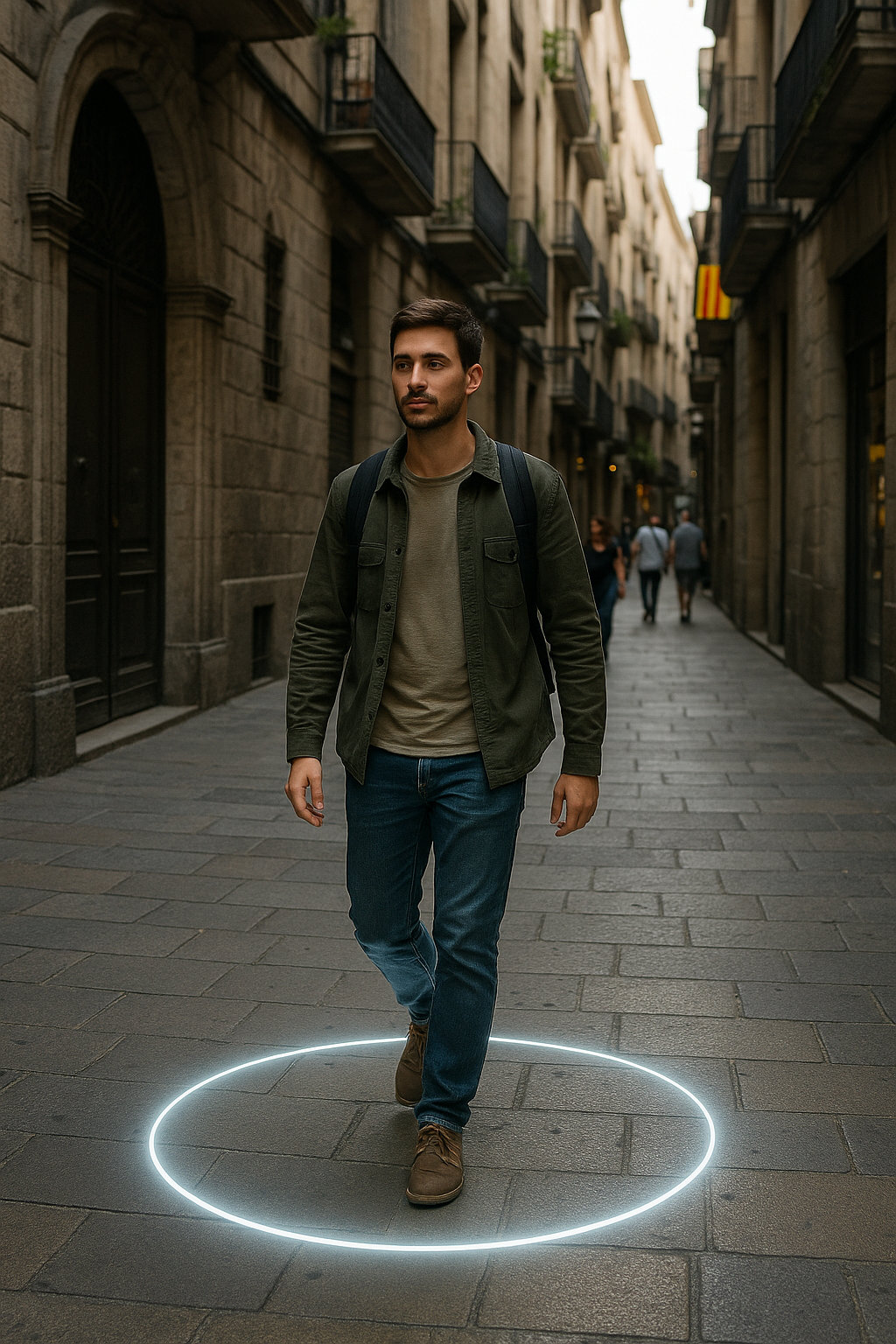
BARCELONA — In an effort to ease congestion and improve the “psychological comfort” of visitors in dense public areas, Barcelona has introduced what city planners are calling “Pedestrian Bubbles,” a spatial management system that projects softly glowing circles around individuals as they walk. The initiative, which launched this week along the Ramblas and the Gothic Quarter, uses overhead sensors and pavement-embedded projectors to maintain a customizable, one-meter zone of personal space around each person.
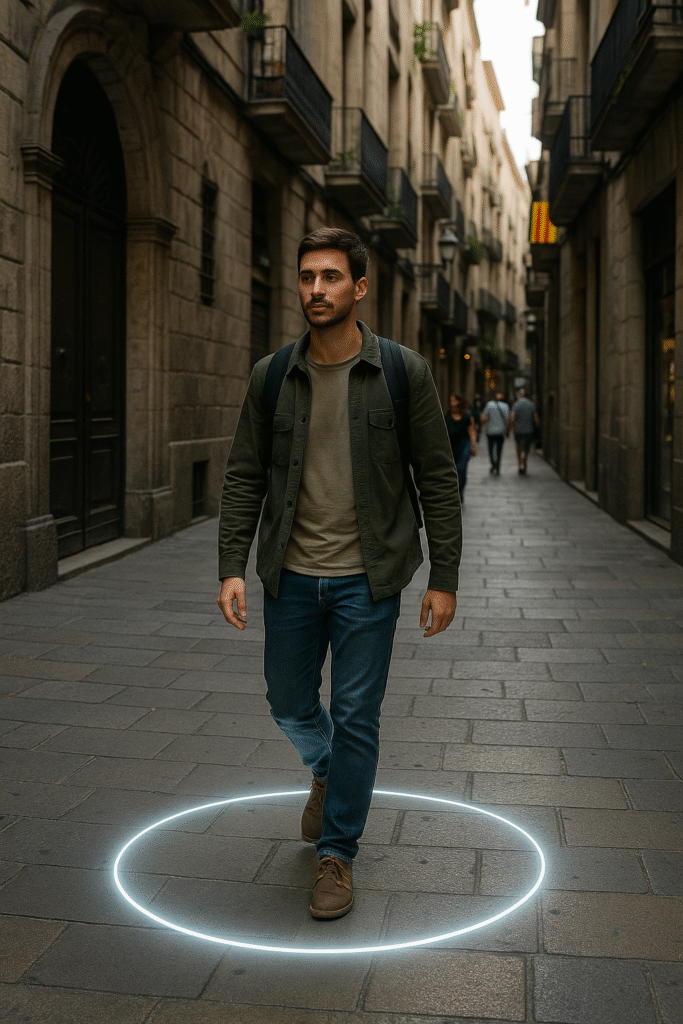
City officials describe the project as an experiment in “ambient urban courtesy.” The system’s cameras and lidar arrays detect human outlines and emit circular fields of light, gently adjusting their diameter to prevent overlap. If two circles collide, they flicker briefly in amber — a polite warning for one or both parties to step aside. “We are not enforcing separation,” said a city mobility engineer at Tuesday’s unveiling. “We are visualizing civility.”
The technology, developed through a partnership between a Catalan design institute and a Dutch robotics firm, originated in post-pandemic crowd studies. Researchers found that perceived proximity — rather than actual density — was the key driver of stress in pedestrian environments. “It’s about agency,” one researcher explained in a briefing note. “When people see their own buffer, they relax, even if nothing physical has changed.”
Initial reactions have been mixed. Some residents describe the glowing orbs as “soothing,” while others complain that they make the sidewalks look like a video game. “It’s pretty, but I feel like I’m in a tutorial level,” said one shopkeeper, whose storefront now glows faintly blue at night. Tour guides have noted that large groups tend to fragment as each tourist instinctively tries to maintain their bubble, making herd management more challenging.
City psychologists, meanwhile, have reported intriguing side effects. “We’re seeing reductions in shoulder-to-shoulder aggression,” said Dr. Eva Renard of the Institute for Urban Wellbeing. “But we’re also seeing increased hesitation — people pause rather than negotiate space through subtle social cues. It’s a technological politeness that suppresses human improvisation.”
Economists have begun speculating about knock-on effects for retail behavior. Early heat maps show that visitors in the bubble zones linger longer near open plazas but avoid narrow alleyways, inadvertently reducing foot traffic to smaller shops. Municipal analysts are already drafting algorithms to “taper” bubble size near commercial corridors. “Dynamic empathy,” one official called it.
Environmental advocates have questioned the system’s energy footprint, though the city maintains that the low-power LEDs consume less electricity than a single streetlight per block. “If it reduces stress and disorder, the cost is negligible,” a spokesperson said. Nighttime aerial photographs, now trending online, show glowing constellations of human movement across the old city — a living map of self-contained motion.
The pilot phase will run through February, after which sensors will collect anonymized behavioral data to determine whether the bubbles genuinely improve flow or merely “prettify friction.”
For now, the effect is mesmerizing: streets that once pulsed with shouts and shoves now glide in silence, each person moving within a faint circle of light — together, but carefully apart.